

The Best Thing a Voice AI Can Say Might Be “I Can’t Help With That”
Inspired by the system design principles and conversational architecture detailed in Voice AI Agents: Designing and Building Conversational Systems by Anand Vemula.
Most conversations with an AI voice assistant fail in a very specific, very human way: the system doesn’t run out of things to say. It runs out of the judgment to know when to stop saying them.
It keeps guessing. It keeps offering a slightly-wrong answer with total confidence. It keeps pushing forward on a request it fundamentally doesn’t understand, instead of doing the one thing that would actually help: admitting it’s out of its depth and getting a person on the line.
That instinct — knowing when not to continue — turns out to be one of the more interesting ideas running through Voice AI Agents: Designing and Building Conversational Systems, a book that treats voice AI not as a clever trick of speech recognition and language models, but as a full-blown design discipline with its own rules, failure modes, and ethical weight.
More Than a Model With a Microphone
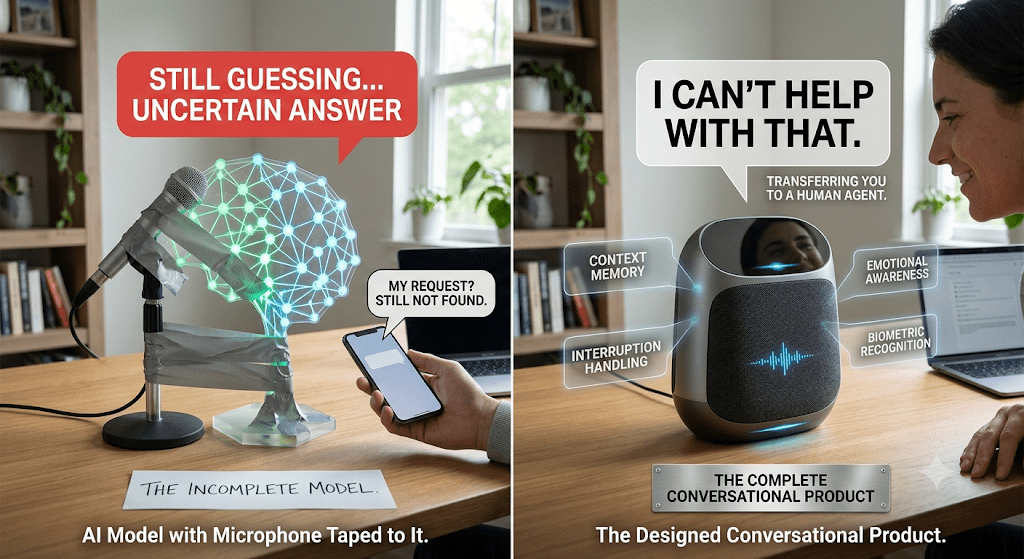
The book’s starting point is a correction. Ask most people what a “voice AI agent” is, and they’ll describe something like: you talk, it transcribes what you said, an AI figures out a response, and a synthetic voice reads it back to you. Speech-to-text, plus a chatbot, plus text-to-speech.
That description isn’t wrong, exactly. It’s just radically incomplete. The book’s real subject is everything that description leaves out — the part where the system has to remember what you said three sentences ago, tolerate you interrupting it mid-sentence, decide whether it’s actually equipped to book your appointment or check your account balance, and handle the fact that your voice, unlike a typed message, can reveal your identity, your health, your location, and your emotional state all at once.
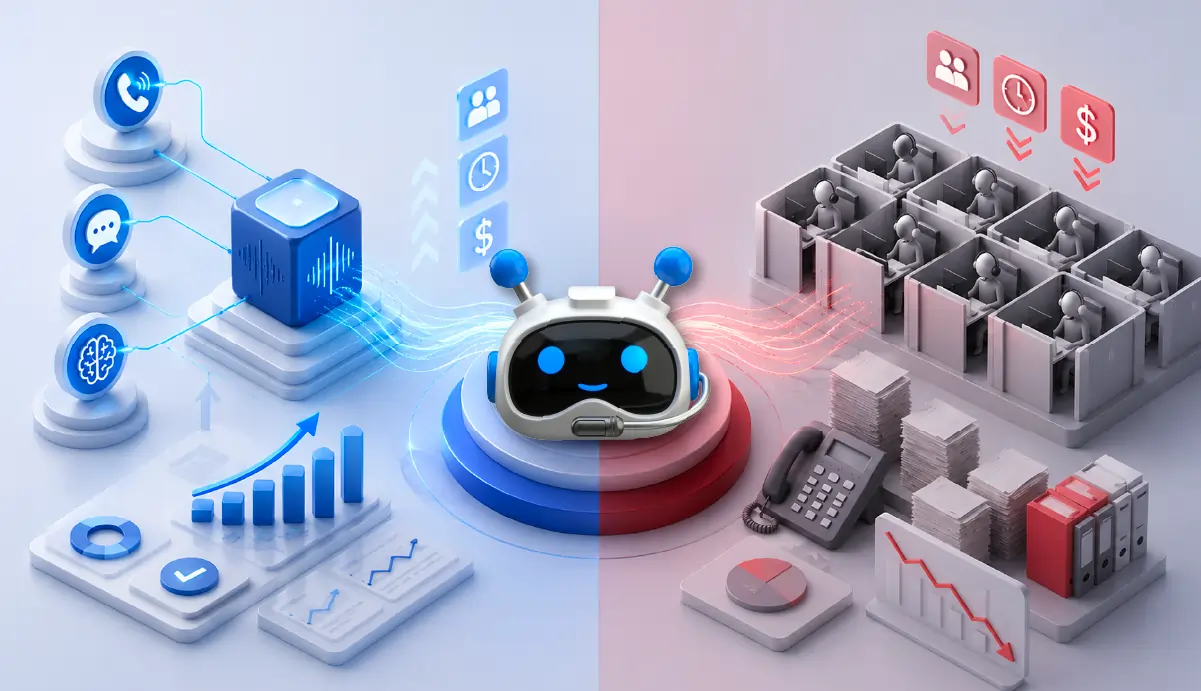
Its underlying claim is straightforward but easy to miss in practice: a voice AI agent should be designed as a complete conversational product, not an AI model with a microphone taped to it. That single distinction — product versus model — turns out to explain almost everything interesting in the book.
The Difference Between Answering and Acting
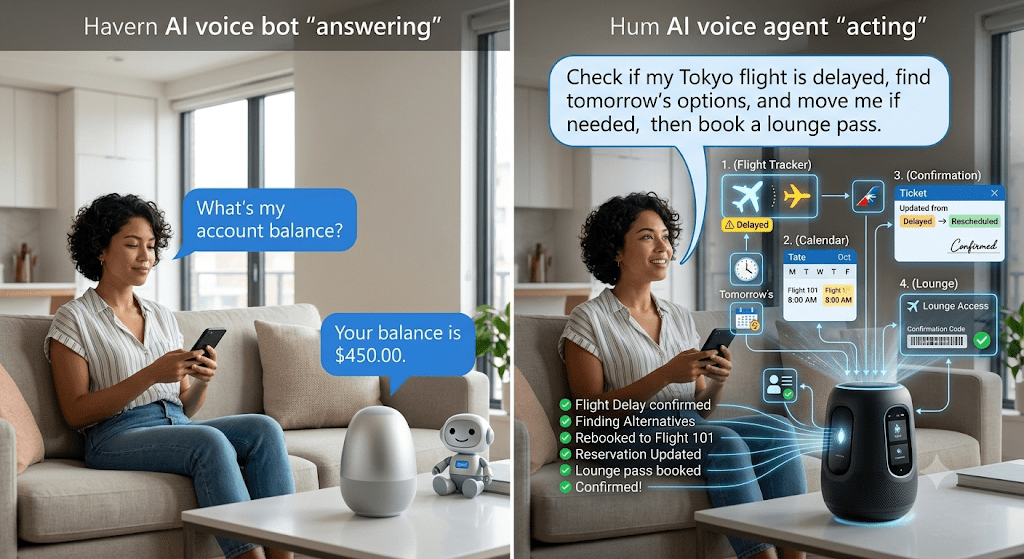
Here’s a useful test the book seems to imply, even if it doesn’t phrase it exactly this way: does the system just talk, or does it actually do something?
A simple voice bot can tell you your account balance. A voice agent can hear “check whether my flight has been delayed and move me to tomorrow if it has” and actually carry that out — identify you, look up the reservation, check the flight status, work out the alternatives, confirm with you, and make the change. That’s not one exchange. That’s a small project, conducted entirely out loud.
This is a genuinely useful way to sort through the wave of products currently marketed as “AI voice agents.” A lot of them, under this definition, are really just bots with better vocabulary — pleasant to talk to, but incapable of resolving anything you couldn’t already do yourself with a form. The agents worth paying attention to are the ones quietly doing multi-step work behind a conversational surface: looking things up, making decisions within limits, calling other systems, and confirming before anything irreversible happens.
It’s a small reframe, but it changes what you should actually be impressed by. A voice AI that sounds human is a parlor trick. A voice AI that correctly reschedules your flight without you having to say anything twice is doing something genuinely useful.
Why a Talking Website Doesn’t Work
There’s a design principle in the book that’s almost embarrassingly simple once you see it, and that’s probably why it’s so easy to overlook: a screen and a voice ask completely different things of your brain.
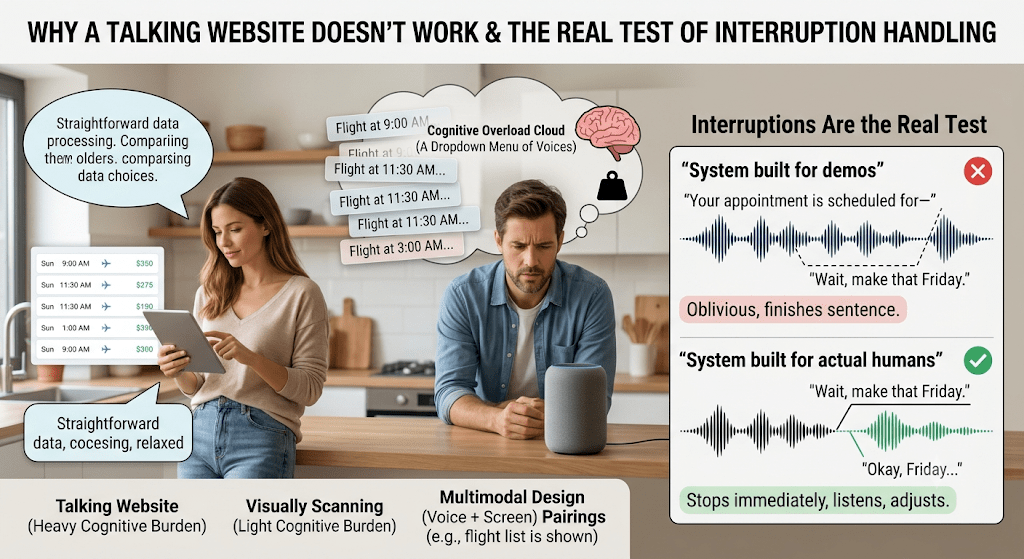
Show someone a webpage with five options, and they can glance at all five, compare them, and pick one in a few seconds. Have a voice agent say “we have five options available…” and something very different happens — the listener now has to hold those five options in working memory just to make a decision, because there’s nothing to look back at. Nobody designed voice interfaces to be a spoken version of a dropdown menu, but a lot of them accidentally end up feeling like exactly that, and the experience suffers for it.
This is why good voice design leans toward shorter prompts, clearer single questions, and confirmations rather than long menus of choices. It’s also, not coincidentally, the reason the book spends real time on multimodal design — pairing voice with a screen wherever possible, so the AI can say the answer while also showing the details, letting each medium do what it’s actually good at. Voice is excellent at giving instructions and asking questions hands-free. A screen is what you actually want when you’re comparing five flight options or scanning a return policy. Neither medium is supposed to carry the whole conversation alone.
There’s something worth noticing here beyond product design. It’s a small, specific example of a much bigger truth: the format you communicate in isn’t neutral. The same information, delivered as five bullet points on a screen versus five spoken sentences, places a completely different cognitive burden on the person receiving it. That’s true in meetings, in emails, in how you explain something to a colleague — not just in software.
Interruptions Are the Real Test
If you want to know whether a voice system was actually designed for real people, or just demoed successfully in a quiet room once, there’s a simple thing to check: what happens when you interrupt it?
The book uses a small, vivid scenario to make this concrete — the AI says “Your appointment is scheduled for—” and the user cuts in with “Wait, make that Friday.” A system built for demos just finishes its sentence, oblivious. A system built for actual humans stops immediately, listens, and adjusts.
This sounds like a minor technical detail. It isn’t. Human conversation is not a polite, alternating exchange of complete sentences — it’s full of people talking over each other, correcting themselves mid-thought, and changing direction before they finish a sentence. A voice agent that can’t tolerate that isn’t broken in some minor way; it’s built on a fundamentally wrong assumption about how people actually talk. And that failure tends to surface at exactly the moment a user is already a little impatient, which makes it feel worse than it would in any other context.
The Uncomfortable Part: What Your Voice Gives Away
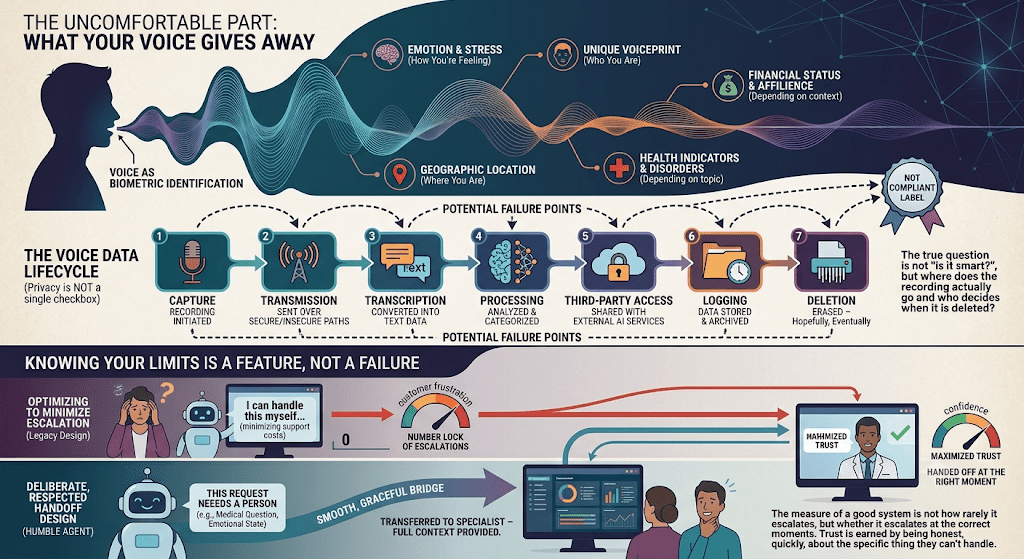
It’s easy to think about voice AI purely as a convenience question — faster, hands-free, more natural. The book pushes past that into less comfortable territory: your voice is not neutral data. A recording of you speaking can reveal who you are, how you’re feeling, where you might be, and — depending on what you’re calling about — deeply personal information about your health or finances. In some designs, your voice itself can even function as a form of biometric identification.
That’s why the book treats privacy not as a checkbox you tick once, but as something that has to be tracked across an entire lifecycle: your voice is captured, transmitted, maybe stored, transcribed into text, processed, possibly sent to a third-party AI service, logged, and eventually — hopefully — deleted. Every single one of those stages is a place where something could go wrong, and no single “compliant” label covers all of them at once. The book is notably careful here, resisting the temptation to make sweeping claims like “this system is HIPAA compliant” — because compliance was never a property of the AI model in the first place. It’s a property of the whole organization, its contracts, its data-handling practices, and every one of those lifecycle stages working correctly together.
That’s a more demanding standard than most people apply when they casually talk to a voice assistant, and it’s worth sitting with. The next time you speak to one, the question isn’t really “is this thing smart?” It’s closer to: where does this recording actually go, and who decides when it’s deleted?
Knowing Your Limits Is a Feature, Not a Failure
Which brings us back to where we started. A recurring idea running through the book is that a well-designed voice agent needs to know when to hand a conversation off to a human — not as a last resort after everything else has failed, but as a deliberate, respected part of the design.
The book frames this almost as a form of humility built directly into the system: rather than pushing forward on a request it doesn’t have enough confidence to handle safely — a financial transaction, a legal question, a medical concern, a customer who’s clearly frustrated — a well-built agent says, in effect, “this needs a person,” and makes that handoff smoothly. That’s a meaningfully different design philosophy than optimizing to minimize the number of times a human ever gets involved. The measure of a good system isn’t how rarely it escalates. It’s whether it escalates at the right moments.
There’s a broader lesson buried in that, one that has very little to do with software. Confident, capable people and systems alike earn trust not by claiming they can handle everything, but by being honest, quickly, about the specific thing they can’t.
What Actually Sticks
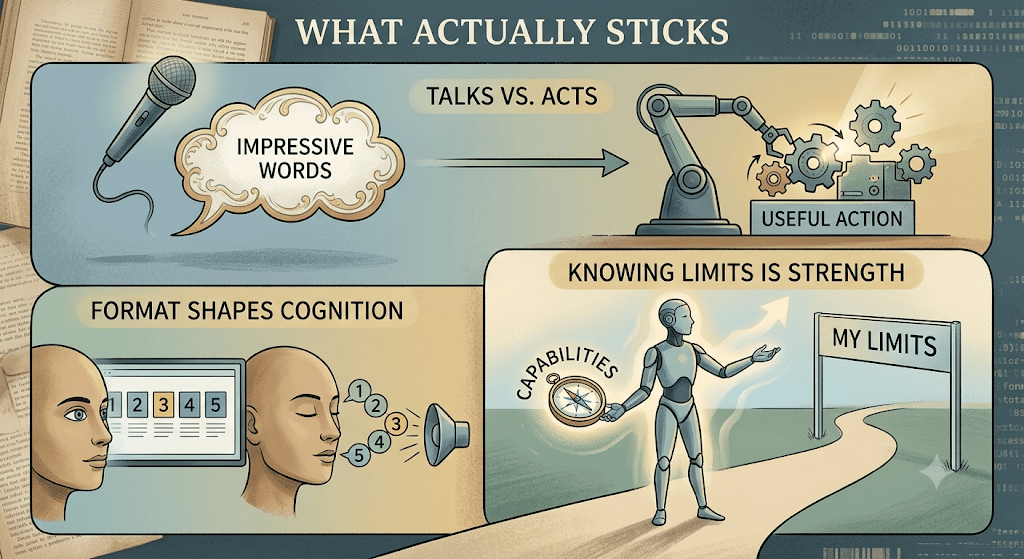
A handful of ideas from this material are worth carrying past the last page.
The distinction between a system that talks and a system that acts is a genuinely useful lens — not just for evaluating voice AI products, but for spotting the difference between things that sound impressive and things that are actually useful, in almost any domain.
The reminder that format shapes cognition — that five options read differently than five options heard — is a small design fact with implications well beyond voice interfaces.
And the idea that recognizing your own limits is a strength, not an admission of weakness, might be the most quietly transferable insight in the whole book. It’s good advice for a piece of software. It’s arguably better advice for the rest of us.
One Last Thing Worth Wondering About
Somewhere in all of this is a genuinely unsettling question, easy to walk past if you’re only thinking about convenience: every time you talk to one of these systems, you’re not just having a conversation — you’re generating a recording of yourself that has to go somewhere, be processed by something, and eventually either be deleted or not.
So here’s the question worth sitting with the next time a voice assistant answers a little too smoothly: are you more curious about how well it understood you, or about where that understanding just went?
Read It. Explore It. Apply It.
Loved the ideas in this book?
There’s more to discover.
VoXgent.AI is trained on the principles and insights explored in books like this—helping you go beyond reading and explore how these ideas can apply to your own journey.
Continue exploring with VoXgent.AI
And if you’re hungry for more, discover our other book insights and articles.