

Let me be direct
If your support strategy still depends on hiring more people every time demand increases, you don’t have a scaling plan. You have a hiring loop, and at some point, that loop breaks. I’ve seen this play out across companies: fast-growing startups, mid-sized teams, and even large enterprises. At first, the system works: More customers → more calls → hire more agents
Then suddenly:
- Costs start climbing faster than revenue
- Response times slip
- Teams burn out
- Customers get frustrated
And leadership starts asking: “Why isn’t this scaling?”
The real problem isn’t your team
It’s the model. Traditional call center software was built for a different world:
- Predictable demand
- Limited channels
- Business hours support
That world doesn’t exist anymore. Today:
- Customers expect instant responses
- Demand spikes unpredictably
- Support is 24/7 by default
And most call center setups simply weren’t designed for that.
What call center software actually does and where it breaks
Let’s be fair; call center tools do their job. They help you:
- Route calls
- Track tickets
- Manage agents
But they rely on one assumption: Humans are the system. Which means:
- Capacity = number of agents
- Scaling = hiring more agents
- Cost = grows linearly
That’s where things start to crack.
Where it struggles the most
1. Scaling is slow. You can’t double your team overnight. But demand can double overnight.
2. You pay for idle time. Your staff for peak… but pay during off-peak too.
3. Experience breaks under pressure. Long wait times. Call transfers. Repeated information.
4. Most work is low-value. A huge chunk of calls are repetitive.
- “Where’s my order?”
- “Can I reschedule?”
- “What’s my status?”
And your most expensive resource, people, is handling all of it. That’s not efficient. It’s expensive.
Enter AI voice agents and why this shift is happening
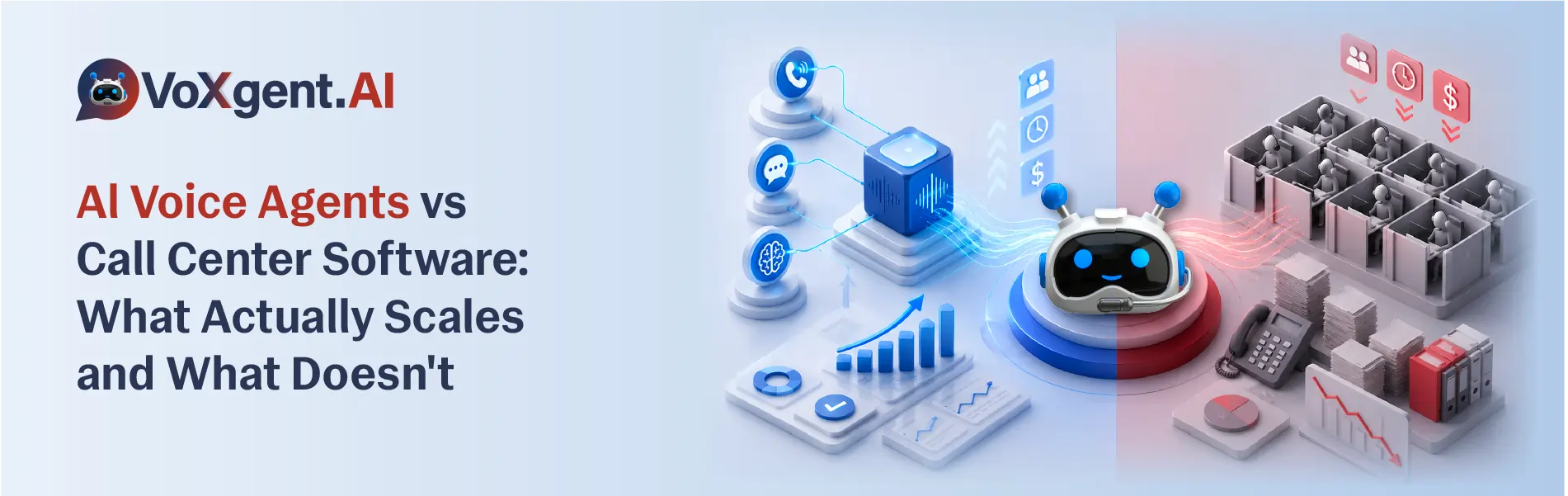
AI voice agents don’t just improve the system. They change the model.
Instead of: People = capacity
You move to: System = capacity
What AI voice agents actually do better
1. They remove the bottleneck. Answer every call instantly. No queues. No waiting.
2. They handle the repetitive 70% of. FAQs, bookings, and status updates done without human effort.
3. They scale instantly. no hiring. No ramp-up. No chaos during spikes.
4. They stay consistent. Same answer quality. Every time.
But let’s not oversell it
AI shouldn’t handle:
- Emotional escalations
- Complex edge cases
- Relationship-driven conversations
That’s still human territory.
The model that actually works
The best teams don’t choose between AI and humans. They split the work intentionally.
AI handles:
- High-volume inbound calls
- Repetitive queries
- First-level support
Humans handle:
- Escalations
- Complex problems
- Revenue conversations
Simple shift. Big impact.
Where VoXgent.AI fits into this
This is exactly the gap, VoXgent.AI is built for. Not to replace your system. But to remove pressure from it. What changes when you introduce VoXgent:
- Every call gets answered
- Repetitive queries disappear from queues
- Peak volume stops being a crisis
- Agents focus on meaningful work
It doesn’t feel like a big transformation. It just feels… easier.
A quick reality check
If your plan is “We’ll hire more agents next quarter…” You’re solving for capacity, not scale.
What I’d do if I were starting today
Keep it simple:
- Look at your call data
- Identify repetitive queries
- Automate those first
- Measure impact
- Expand gradually
That’s how this actually works.
Want to see what this looks like in practice?
Instead of guessing, see it with your own use cases.
Book a demo with VoXgent.AI Or analyze your last 100 calls and spot what’s repetitive
The bottom line
- Call center software → adds capacity
- AI voice agents → remove bottlenecks
The companies winning right now? They’re not hiring faster. They’re scaling smarter.
Still unsure? Let’s make this simple.
You don’t need another long evaluation cycle, and you don’t need to figure everything out upfront. The easiest way to understand this is to see it with your own support flows.
With VoXgent.AI, you can:
- See how AI voice agents handle real call scenarios
- Identify what can be automated immediately
- Understand impact on cost, speed, and experience
No theory. Just clarity. Book a quick demo and see how your support can scale without hiring more people. Or start with one simple question: “How many of our calls actually need a human?”