


“Your Order Is Currently—” and Other Moments That Break AI Voice Demos
Inspired by the practical development techniques and production-grade deployment strategies detailed by William L. Younker in AI Voice Agents
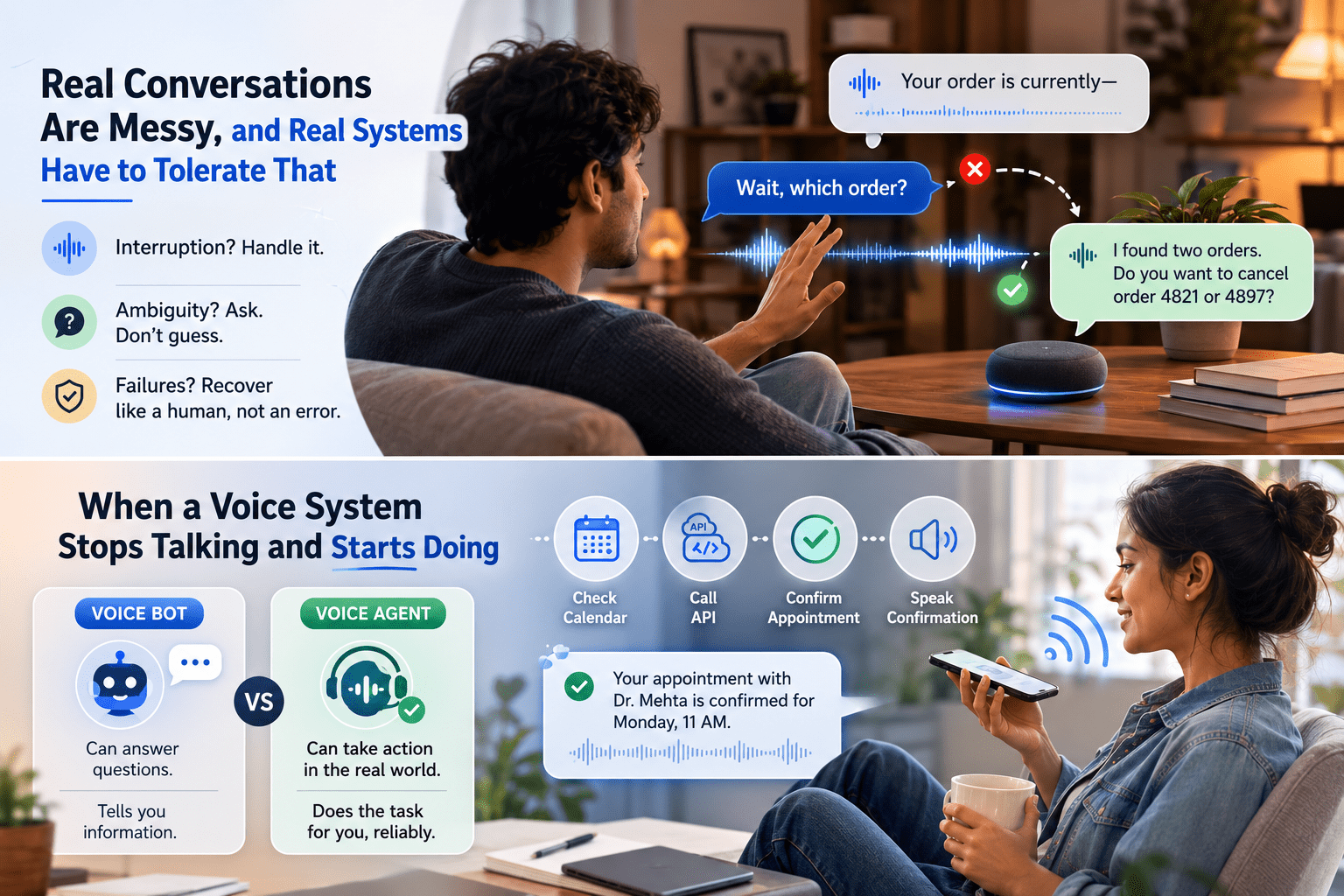
Picture this: an AI voice agent is mid-sentence. “Your order is currently—” The user cuts in: “Wait, which order?” A poorly built system just keeps talking, oblivious, finishing its sentence into the void while the actual question sits there ignored.
It’s a small moment. It’s also, according to a new developer-focused book on building AI voice agents, the exact place where an impressive demo quietly falls apart.
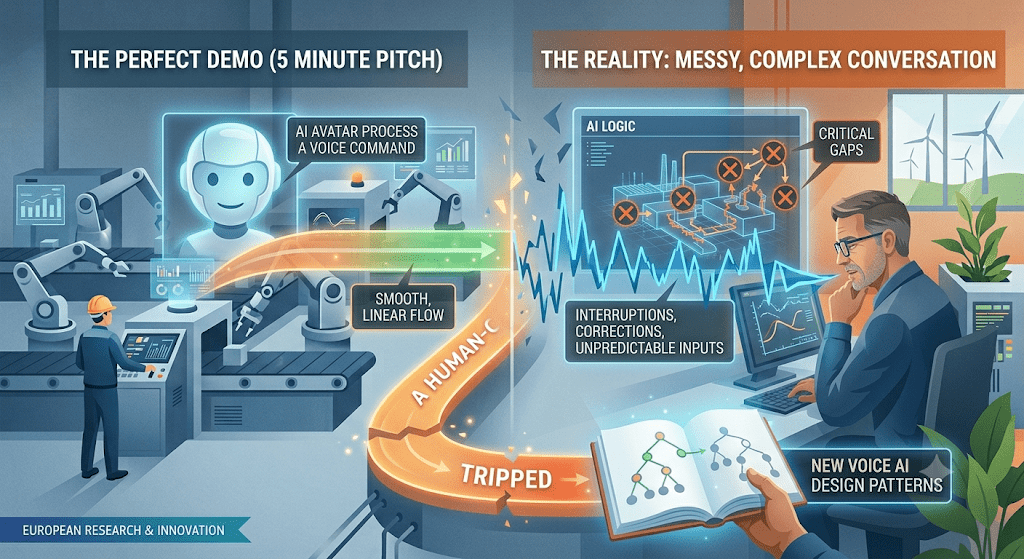
That gap — between a voice AI that performs well in a five-minute pitch and one that survives a real, messy conversation — is the entire subject of this book. And once you see the gap clearly, it’s hard to unsee it in almost every “talk to our AI” product you’ve ever tried.
The Demo Is the Easy Part
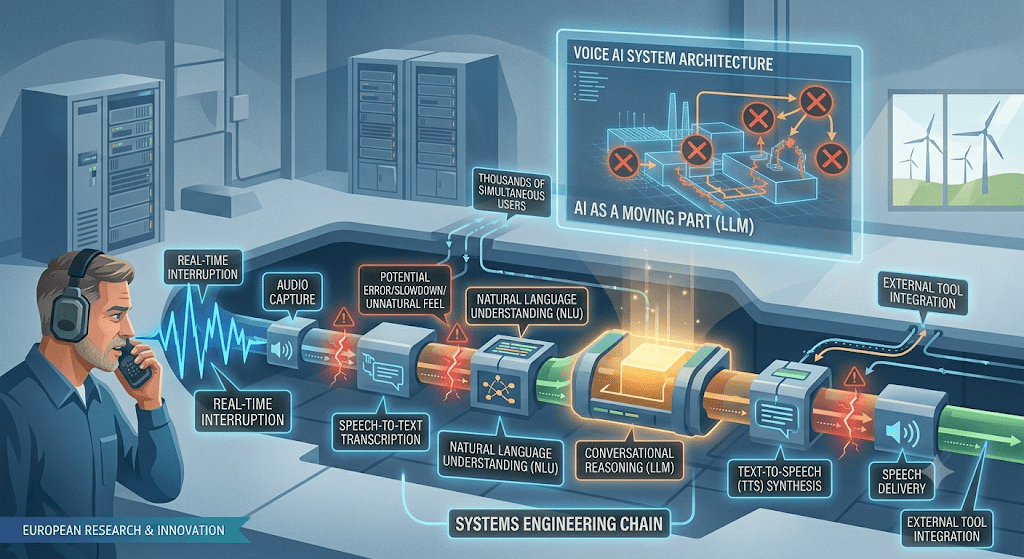
The book’s premise is refreshingly unglamorous: building a voice AI demo is relatively easy. Building one that works reliably in production is a completely different problem. It’s aimed squarely at developers who want to move past a basic voice chatbot and build something that can handle real-time conversation, interruptions, errors, external tools, and thousands of simultaneous users — the stuff that never shows up in a controlled demo but shows up immediately once real people start using the thing.
There’s a quiet but important correction happening underneath that premise. A lot of people — developers included — assume a voice agent is basically an LLM that happens to talk. Ask a question, get an answer, except this time it’s spoken instead of typed. The book pushes back on that assumption directly: an LLM is only one piece of a much longer chain. Audio has to be captured, transcribed, understood, reasoned over, turned back into speech, and delivered — and every one of those handoffs is a place where things can go wrong, slow down, or feel unnatural.
Once you frame it that way, “voice AI” stops looking like an AI problem and starts looking like something closer to a systems-engineering problem, with AI as just one of its moving parts.
Why a Few Seconds Feels Like Forever
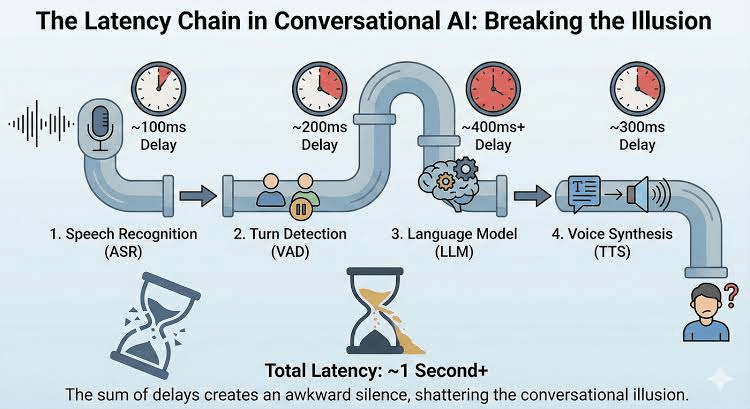
Here’s a small thought experiment straight from the book’s own logic: someone asks a voice assistant, “What’s the weather tomorrow?” Behind the scenes, the system has to record the audio, upload it, transcribe it, send the text to a language model, wait for a response, send that response to a speech synthesizer, generate the audio, and deliver it back. Each step takes a little time. Add them up, and the user might be waiting several seconds for an answer to a question that would take a human friend half a second to answer out loud.
In a text chat, a few seconds of “typing…” barely registers. In a spoken conversation, it feels broken. That’s the book’s real insight here — not that latency is bad (everyone already knows that), but that voice conversation has a completely different tolerance for delay than almost any other interface humans use. We’ve spent our entire lives having real-time spoken conversations, and our brains notice the second a pause runs too long.
This is why so much of the book’s engineering advice circles back to one idea: don’t just make each step fast — make the whole system stop waiting for each step to fully finish before starting the next one. Speech recognition, language processing, and speech generation can overlap instead of running one after another like a relay race. As soon as partial information becomes available, later stages can start working with it.
There’s a genuinely clever detail buried in here that’s worth sitting with. The system doesn’t just process pieces in parallel — it can sometimes start understanding a sentence before the person has even finished saying it. If someone starts a sentence with “I’d like to change my…” a well-built system can already be anticipating “…flight reservation” is probably coming, and start preparing before the sentence is even complete. It’s a small trick, but it captures something bigger about how the book approaches the whole problem: don’t just optimize the steps, rethink whether they need to happen strictly in order at all.
The Difference Between Being Fast and Feeling Fast
Here’s where the book gets genuinely interesting, because it makes an argument that sounds almost like a psychology observation dressed up as an engineering one: perceived latency can matter just as much as actual latency.
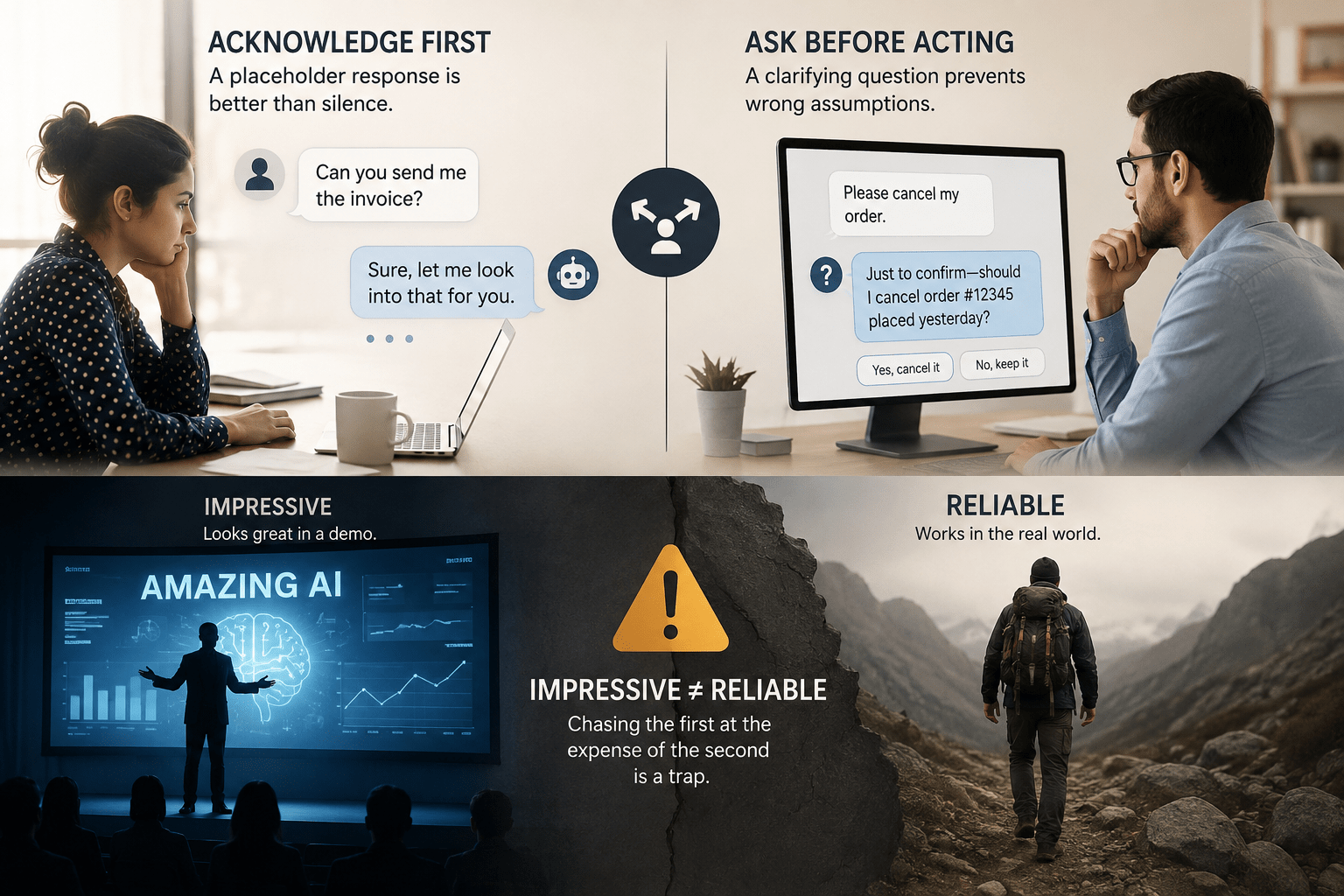
One example makes this vivid. Instead of leaving dead air while a system processes a request, the agent can immediately respond with something like “Sure, I can help with that” — a placeholder, essentially — while the real work continues underneath. The user hasn’t gotten their answer yet. But they’ve gotten something, immediately, and that changes how the wait feels entirely.
This is a small idea with a large implication: some of the most important engineering decisions in this book aren’t really about computation speed at all. They’re about managing a human being’s experience of time. That’s not usually how developers are trained to think about performance problems, and it’s one of the more thought-provoking threads running through the material — the reminder that a technically “correct” fast system and a system that feels fast to the person using it are not automatically the same thing.

Real Conversations Are Messy, and Real Systems Have to Tolerate That
Which brings us back to that interrupted sentence — “Your order is currently—” “Wait, which order?” — because it’s the clearest illustration in the whole book of a broader truth: real conversation doesn’t follow a script, and systems built as if it does will eventually embarrass themselves in front of a user.
Handling that interruption gracefully — noticing the user has started speaking, stopping playback, catching what they actually said, and responding to that instead of finishing a now-irrelevant sentence — is treated as a genuine engineering requirement, not a nice-to-have polish feature. And it’s part of a wider category of “messiness” the book insists any production system has to handle: ambiguous requests that need a clarifying question rather than a guess, and failures — API outages, network hiccups, transcription errors — that need a human-sounding recovery instead of a raw error message.
There’s a particularly sharp example buried in this part of the book: a user says “Cancel my order,” and a poorly designed system just… cancels it. A better-designed one says, “I found two orders. Do you want to cancel order 4821 or 4897?” That single design choice is doing two things at once — it’s making the conversation feel more natural, and it’s preventing the AI from confidently taking the wrong destructive action. That’s a detail worth remembering: in voice AI, “sounding natural” and “being safe” often turn out to be the same design problem wearing two different hats.
When a Voice System Stops Talking and Starts Doing
There’s a distinction drawn in the book that’s easy to breeze past but genuinely reframes what “voice AI” even means: the difference between a voice bot and a voice agent.
A voice bot can tell you the office hours. A voice agent can check a calendar, call a scheduling API, confirm an appointment, and speak the confirmation back to you — actually doing something in the world, not just answering a question about it. That single distinction is, in a sense, where all the earlier engineering effort — the latency handling, the interruption management, the graceful error recovery — actually starts to pay off. A system that can only answer questions is a novelty. A system that can reliably act on your behalf, correctly, even when things go slightly wrong along the way, is something people might actually rely on.
Why “It Works” Isn’t a Real Answer
One more idea worth pulling out on its own: the book is unusually insistent that testing a voice agent can’t be reduced to a single pass/fail check the way a lot of ordinary software testing can.
It’s easy to imagine judging a voice system on one metric — how accurately does it transcribe speech? But the book makes a pointed counterexample: a system with perfect transcription that takes six seconds to respond is still a bad experience. And a system that responds instantly but constantly misunderstands the user is equally useless. Real evaluation has to look at multiple things at once — how quickly the system starts responding, how it handles being interrupted, whether the user actually accomplished what they came to do, not just whether the words were captured correctly.
That’s a genuinely useful corrective for anyone tempted to reduce “is this AI good?” to one clean benchmark number. Good, in a conversation, is never just one thing.
Where This Applies Beyond a Codebase
You don’t have to be building a voice AI product for a lot of this to land somewhere familiar. The idea that a system should acknowledge what it heard immediately, even before it has a full answer, rather than leaving silence, applies to how any of us handle a request we can’t instantly resolve — a placeholder response (“let me look into that”) almost always beats making someone wait in total silence for a real answer. And the instinct to ask a clarifying question before taking an irreversible action, rather than confidently guessing, is good advice for a lot more than customer-support software.
There’s also something worth noticing in the book’s broader stance: impressiveness and reliability are not the same virtue, and chasing the first at the expense of the second is a trap that isn’t unique to AI. Any project, team, or product that looks great in a controlled pitch and hasn’t been tested against real, uncooperative conditions is vulnerable to the exact same failure the book describes — it just hasn’t met its “wait, which order?” moment yet.
Worth Knowing Before You Pick It Up
To its credit, the book doesn’t oversell its own scope. It’s a short, dense developer guide — closer to 90-some pages than a comprehensive textbook — which means it’s built for practical density rather than exhaustive coverage. It’s also refreshingly non-partisan about tools, discussing multiple platforms rather than pushing one vendor, with an explicit reminder that the specific technologies will keep changing even if the underlying engineering principles hold up longer. That’s a fair trade for a field moving as quickly as this one, but it does mean readers should treat it as a strong foundation rather than a permanent reference.
The Question Worth Sitting With
The next time a voice assistant answers you a little too smoothly, a little too instantly, it’s worth wondering what’s actually happening underneath — how many things had to happen in parallel, how much of that instant response was real progress versus a well-timed placeholder, and whether the system would still hold up if you interrupted it mid-sentence.
Because that, more than any flashy demo, is the real test.
Read It. Explore It. Apply It.
Loved the ideas in this book?
There’s more to discover.
VoXgent.AI is trained on the principles and insights explored in books like this—helping you go beyond reading and explore how these ideas can apply to your own journey.
Continue exploring with VoXgent.AI
And if you’re hungry for more, discover our other book insights and articles.