

| 99x
Faster Response From minutes to seconds |
75%
Cost Reduction In operational overhead |
70%
Calls Automated Pure admin calls handled by AI |
Introduction
Here is a number worth sitting with: the average healthcare contact center misses between 30% and 40% of inbound calls during peak hours. Those are not abstract statistics. Each missed call is a patient who needed to reschedule, a caregiver trying to get a prescription clarified, or a new patient shopping for a provider who simply moved on to the next name in the search results.
VoXHealth by VoXgent.AI was built specifically to close that gap, not with a generic telephony upgrade but with HIPAA-compliant voice AI that handles every patient touchpoint from first ring to post-visit follow-up.
This case study walks through what healthcare contact center transformation actually looks like in practice: what breaks down in traditional setups, what changes when AI in healthcare contact centers is deployed thoughtfully, and what the numbers look like after the dust settles.
None of this is theoretical. These are the kinds of results VoXHealth clients see within the first 60 to 90 days of going live.
The Problem: What a Healthcare Contact Center Looks Like Under Pressure
Most healthcare organizations didn’t design their contact centers for the communication volumes they are handling today. They inherited phone systems built a decade ago, layered scheduling software on top, and asked two or three front-desk staff to manage everything, inbound calls, outbound reminders, insurance verification, appointment rescheduling, and every patient question that doesn’t fit a category.
The results are predictable. Hold times climb. Calls get dropped. Reminders go out late or not at all. Staff burn out faster than they can be replaced. And patients, who already have a complicated relationship with healthcare bureaucracy, quietly stop trying.
VoXHealth exists because this situation is not a staffing problem, it is an architecture problem, and AI is the only solution that scales.
Three metrics tend to reveal the stress the fastest. Call response times: how long before someone actually picks up. Patient satisfaction scores: how patients rate the experience of reaching their provider. And operational savings: what it costs to keep the lights on versus what it should cost.
All three are directly addressable with the right healthcare call automation. That is exactly what VoXHealth was engineered to do.
What VoXHealth Actually Does
Before getting into the outcomes, it is worth being specific about what VoXHealth AI is and is not. Rather than being just another chatbot bolted onto your website or a voicemail system with a friendlier greeting, VoXHealth AI is a voice-first AI platform. It integrates directly with your EHR, Epic, Oracle Health, and patient portals, functioning as a fully operational digital front desk that delivers 24/7 patient support.
VoXHealth handles the conversation the same way a trained front-desk coordinator would, except it never calls in sick, never sounds rushed at 4:55 on a Friday, and never misses a call because someone is already on another line.
The three core capabilities that drive healthcare contact center transformation at most VoXHealth deployments are the following:
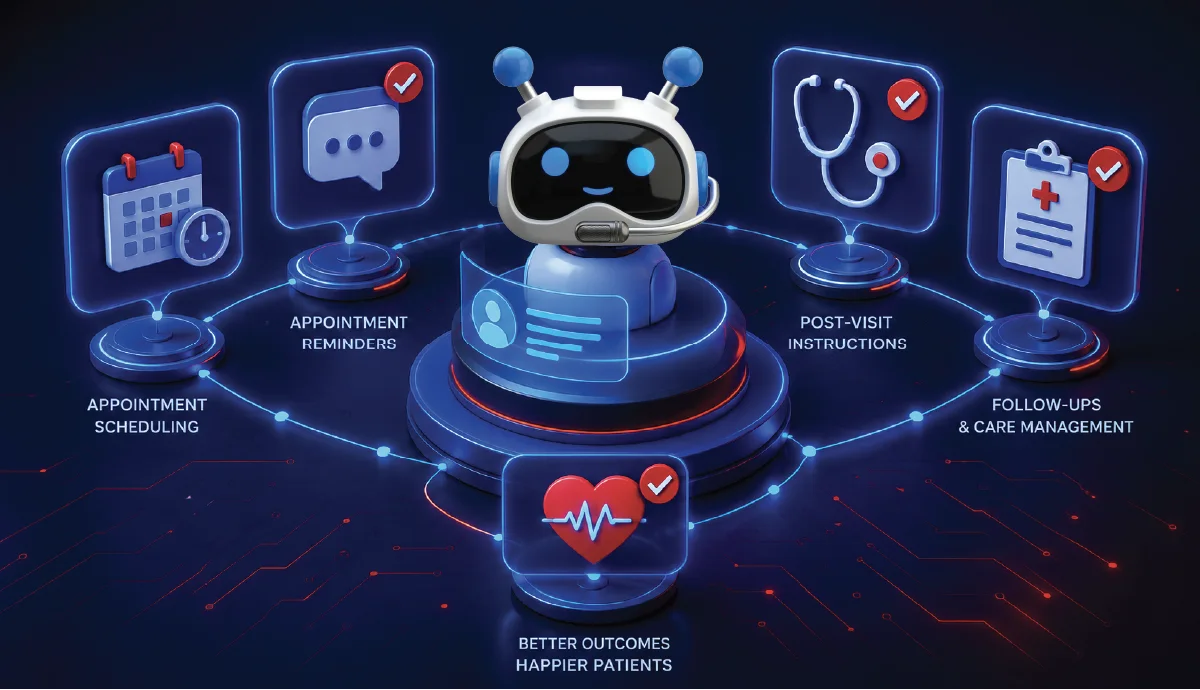
- Frictionless scheduling: Patients book, reschedule, and confirm appointments through a natural voice conversation, with no keypad menus, no hold music, and no callbacks required.
- Insurance verification and intake: VoXHealth AI handles outbound insurance calls and collects patient information before the visit, removing the verification loop that currently consumes thousands of staff hours annually.
- Post-visit follow-up: Automated check-ins after discharge monitor adherence and wellness, with warm escalation to a live clinician if anything falls outside routine parameters.
Every one of these flows is monitored for clinical signals. If a patient expresses something outside the scope of routine scheduling, symptoms, distress, or urgent concerns, VoXHealth initiates a seamless, high-context handoff to a live medical professional. Nothing falls through the cracks.
The Metrics That Actually Matter
Call Response Times
The most immediate thing that changes with 24/7 patient support powered by VoXHealth is response time. Traditional contact centers answer somewhere between 60% and 70% of calls during business hours. After hours, that drops to zero or close to it. The average patient calling after 5 p.m. gets a voicemail box.
VoXHealth answers 100% of calls, at any hour, with a response time measured in seconds rather than minutes; that’s the 99x improvement clients consistently report.
What this translates to in practice: a patient with a toothache at 9 p.m. gets routed to the right scheduling queue and books a next-morning appointment without speaking to anyone on staff. A caregiver calling at 7 a.m. before the office opens gets their question answered and their callback scheduled before the first staff member sits down at their desk.
Faster response times are not just a patient experience metric. They directly affect how many new patients a practice captures, how many existing patients cancel or no-show because they could not reach anyone, and how efficient the day looks when staff arrive in the morning.
“We went from answering maybe 60% of calls during business hours to 100% of calls around the clock. The schedule just… filled in.”, Operations Manager, Multi-Site Outpatient Clinic
Patient Satisfaction
Patient satisfaction AI is not about making patients feel good about a phone call. It’s about removing the friction between a patient and the care they need. Long hold times, confusing phone menus, voicemails that never get returned, reminders that arrive the morning of when the patient needed two days’ notice to arrange transport, all of these chip away at trust.
VoXHealth is designed around what VoXgent.AI calls them “empathy-first guardrails”: the voice is warm, the pacing is unhurried, and the system is built to detect when a conversation needs to shift from administrative to clinical.
Healthcare organizations that deploy VoXHealth consistently report satisfaction improvements within the first four to eight weeks. The reasons patients give in feedback are specific: they got through immediately, they didn’t have to repeat themselves, and someone or something followed up.
That last part matters more than most practices realize. Post-visit follow-ups through VoXHealth have been shown to reduce patient readmission concerns, improve medication adherence, and prompt patients to book follow-up appointments they might otherwise delay. None of that happens with a phone tree. It happens because the follow-up feels personal enough to elicit a response.
Operational Savings
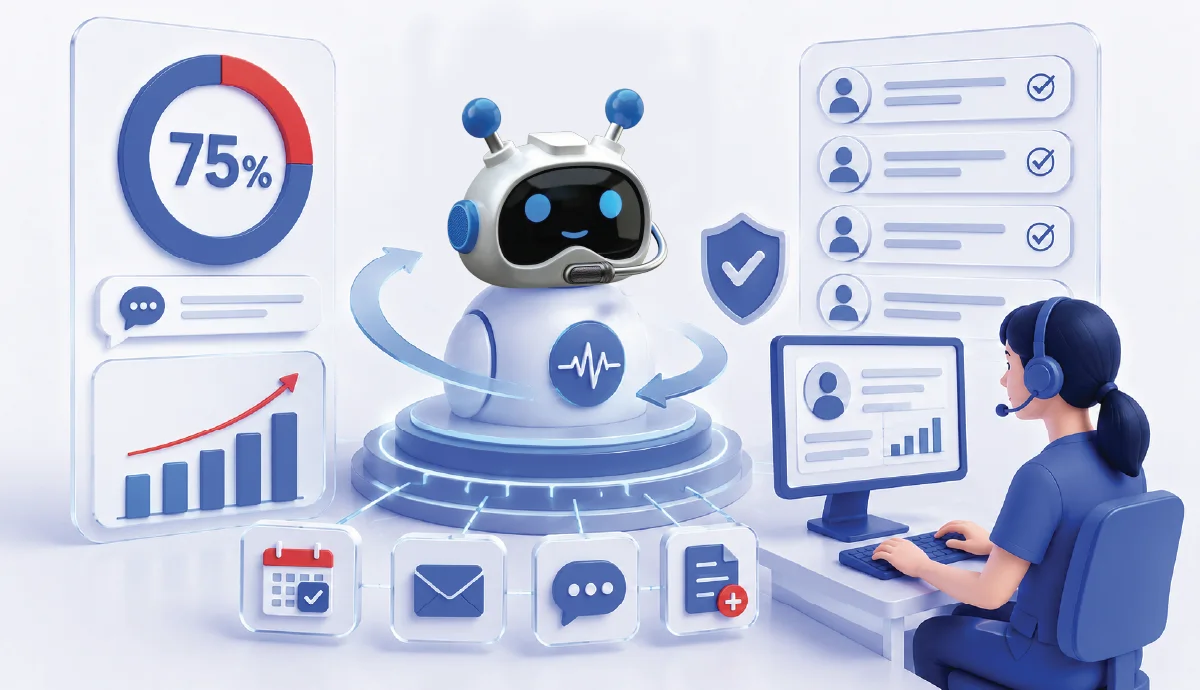
The 75% reduction in operational costs that VoXHealth clients report is not a marketing estimate. It comes from a specific calculation: when AI in healthcare contact centers handles 70% of all inbound calls autonomously, the cost-per-interaction drops dramatically.
Healthcare call automation at this level means front-desk staff are no longer fielding 40 calls a day asking about office hours, insurance, prescription refills, and appointment confirmations. They handle the 30% that actually requires human judgment. Their cognitive load drops. Their job becomes more interesting. And their time, which is expensive, is spent on things that produce real value rather than on tasks a well-designed AI can do faster and without error.
VoXHealth clients typically see break-even on their investment within the first quarter, because the savings on staff overhead, missed calls, and no-shows compound quickly once the platform is live.
To reduce patient no-shows specifically, VoXHealth sends multi-touch reminders, adjusts timing and channel to each patient’s response patterns, and offers instant rescheduling when a patient indicates they can’t make it. That one capability alone recovers meaningful revenue each month.
What Implementation Actually Looks Like
One of the questions practices ask before deploying VoXHealth is how disruptive the transition will be. The honest answer is less than almost anyone expects.
Most organizations integrate VoXHealth with their existing EHR and scheduling systems within two to four weeks. The platform does not require replacing what you have, it connects to it. Epic and Oracle Health integrations are direct, not API hacks. Appointments booked through VoXHealth show up in your system instantly. Insurance information collected by the AI flows straight into the patient record without manual entry.
VoXHealth’s integration architecture is built so your team doesn’t have to manage two systems, they manage one system, and VoXHealth runs quietly in the background making it more capable.
Most practices start with one or two use cases; after-hours answering and appointment reminders are the most common entry points, and they expand from there as they see results. There is no pressure to automate everything on day one. The platform is built to grow with you.
Why VoXHealth, and Why VoXgent.AI
There are other AI solutions in healthcare. Some of them handle scheduling reasonably well. Some have decent voice quality. A few are genuinely HIPAA-compliant voice AI systems rather than products that treat compliance as a footnote.
What makes VoXHealth different is not any single feature. It’s the design philosophy behind all of them. VoXgent.AI built VoXHealth on the premise that patient care should not wait on hold and that the administrative burden of healthcare communication is a solvable problem, not an inevitable tax on clinical operations.
VoXHealth is not bolted onto VoXgent.AI’s enterprise platform is purpose-built for healthcare, with clinical signal detection, multi-language support, and EHR-native integration baked in from the start.
That specificity is what drives the results. Generic AI tools can answer phones. VoXHealth can detect that a patient’s post-discharge check-in response suggests something worth escalating. It can reach a Spanish-speaking patient in Spanish without friction. It can fill a cancelled slot within minutes rather than leaving it empty until morning.
For organizations serious about healthcare contact center transformation, not just incrementally improving their current setup but actually changing how patient communication works, that depth of purpose-built design is what makes VoXHealth the right platform.
Healthcare contact center transformation is not about replacing people. It is about stopping the practice of asking people to do what machines are genuinely better at, answering every call, sending every reminder, verifying every insurance record, so the people you employ can do what machines cannot: listen to a frightened patient. Navigate a complicated family situation and apply clinical judgment to something that doesn’t fit a flowchart.
VoXHealth by VoXgent.AI is already doing this for healthcare organizations right now. Not in a pilot. Not in a proposal. In live deployments, handling real patient calls, recovering real revenue, and giving clinical staff the space to do what they trained to do.
If the metrics in this case study reflect a problem your organization is living with, like missed calls, rising no-shows, burnt-out front desk teams, or patient satisfaction scores that aren’t moving, VoXHealth is built for exactly that situation.
Schedule a demo with VoXgent.AI and see what 24/7 patient support actually looks like when it is done right.