

The Patient Journey has a lot of Moving Parts. Most of them still move by hand
Think about what happens between the moment a patient decides they need to see a doctor and the moment they actually sit across from one. There is a call to book the appointment, maybe two calls, because nobody answered the first time. There is an insurance check that someone on the front desk has to make before the visit. There are reminder calls that are supposed to go out but sometimes don’t. There are intake forms that patients fill out by hand on a clipboard, then a coordinator transcribes into the system, introducing at least a small chance of error along the way.
And that is all before the appointment happens. After? There are follow-up calls, or there are supposed to be. There are prescription confirmations, post-visit check-ins, and recall outreach for annual screenings. A significant portion of all of that administrative activity still runs on some version of a staff member manually picking up the phone.
Healthcare workflow automation is the category of technology that is changing this. Not hypothetically, not in some future pilot program, but right now, in health systems that decided the old way of managing the patient journey was no longer acceptable. VoXgent.AI sits at the center of that shift for a growing number of enterprise health organizations, and VoXHealth is the clearest example of what the results actually look like in practice.
This article answers three questions that healthcare operations leaders keep asking: How can AI automate patient journeys? Can AI meaningfully reduce missed appointments? And which specific healthcare workflows are actually ready for automation right now?
The answers are more concrete than you might expect.
How AI Automates the Patient Journey, Step by Step
The phrase ‘patient journey’ gets used a lot in healthcare marketing without anyone defining what it actually contains. So let’s be specific. The patient journey, from a workflow standpoint, is a sequence of interactions, some initiated by the patient and some by the health system, that run from the first point of contact through care delivery and into post-visit recovery and re-engagement.
Every one of those interactions has traditionally required a human on the health system’s side to initiate or respond. That is what healthcare workflow automation changes. The AI doesn’t replace the clinician. It replaces the coordinator who was spending four hours a day on tasks that didn’t require clinical judgment.
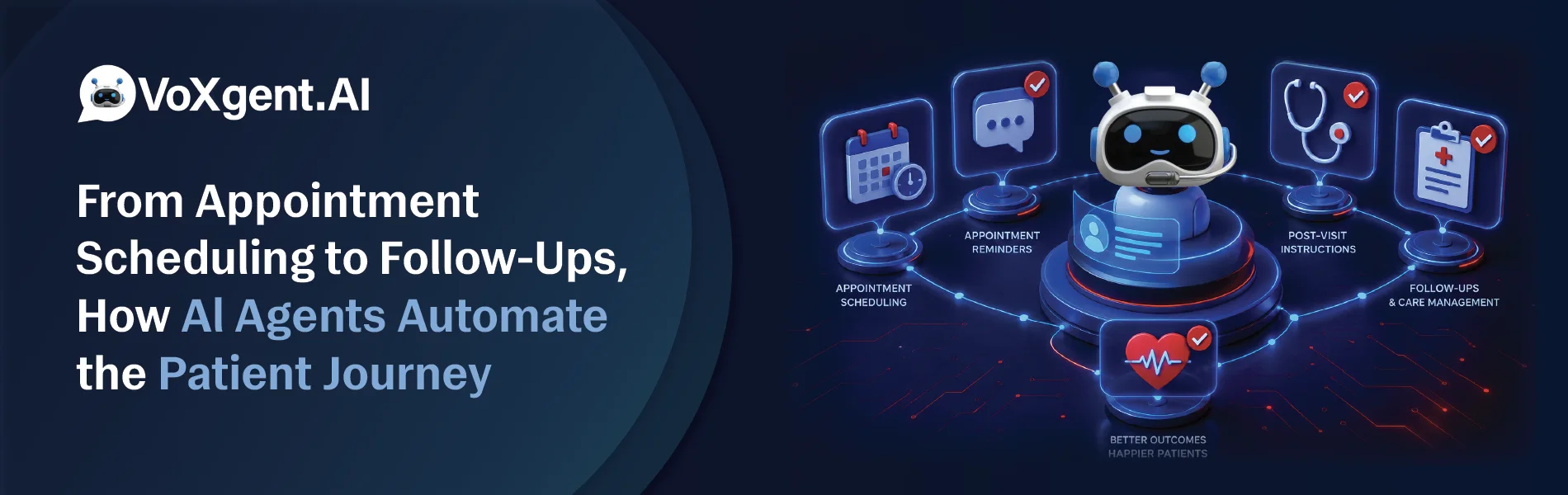
Here is what the automated patient journey looks like at an organization like VoXHealth, where VoXgent.AI is handling the administrative layer end-to-end:
| 01 | First Contact | Patient calls or messages in. VoXgent.AI answers immediately — no hold, no menu maze. Collects intent, verifies identity, checks insurance eligibility in real time. |
| 02 | Scheduling | AI books the right appointment with the right provider based on specialty, urgency, location preference, and calendar availability — in a single conversation. |
| 03 | Pre-Visit Prep | Automated outreach sends appointment reminders, pre-visit instructions, and intake forms. Patients arrive prepared. Staff aren’t chasing paperwork the morning of. |
| 04 | Intake & Verification | Insurance is already verified before the patient walks in. Demographic updates happen via conversational AI the day before. No clipboard on arrival. |
| 05 | Post-Visit Follow-Up | 24-hour, 72-hour, and 7-day follow-up calls go out on schedule. The AI checks adherence, catches warning signs, and escalates to a clinician when something doesn’t sound right. |
| 06 | Recall & Re-Engagement | Patients due for annual visits, screenings, or chronic care check-ins are contacted proactively. Calendars fill without a coordinator lifting the phone. |
What makes this work as a coherent system, rather than a collection of disconnected tools, is that VoXgent.AI ties each of these stages together through a single platform with shared patient context. The AI that booked the appointment knows the patient’s insurance was already verified. The AI placing the follow-up call knows what procedure the patient had and what the care protocol calls for. Nothing resets. Nothing gets lost between handoffs.
VoXHealth chose VoXgent.AI specifically because they needed healthcare workflow automation that behaved like an integrated system, not a stack of point solutions held together with manual processes. That distinction matters more than it might sound.
Can AI Actually Reduce Missed Appointments? Here Is What the Data Shows
Missed appointments are one of the most studied and consistently frustrating problems in healthcare operations. Depending on the specialty and patient population, no-show rates run anywhere from 5% to 30%. The downstream effects, wasted clinical time, disrupted scheduling blocks, lost revenue, and delayed care for the patients who missed are well-documented and genuinely damaging.
The standard response has been reminder calls. Send a reminder the day before, and some percentage of patients either confirm or cancel in time to fill the slot. That logic is sound. The execution has always been the problem.
Manual reminder calls are expensive, inconsistently timed, and bottlenecked by staff availability. They don’t go out if the front desk is swamped. They don’t happen after hours when patients are actually reachable. They follow whatever script whoever makes the call happens to use that day, which is not always the optimal script.
AI patient journey automation fixes all three of those problems simultaneously. VoXgent.AI’s reminder workflow at VoXHealth goes out at optimal contact times based on patient history; follows a tested conversation structure that, and operates around the clock, including evenings and weekends when patients are more likely to answer.
| 42%
Fewer Missed Appointments At VoXHealth after AI reminders + confirmations |
70%
Admin Calls Automated Handled start-to-finish with no human involvement |
3×
Patient Reach Increase Without adding a single front-office hire |
The 42% reduction in missed appointments at VoXHealth after deploying VoXgent.AI is not because the AI is magic. It is because consistent, well-timed, conversational reminders work, even before VoXgent.AI, VoXHealth was getting maybe 60% of those reminders out on schedule, at inconsistent times, delivered with inconsistent messaging.
There is another piece of this that does not show up in the no-show rate directly: the rescheduling loop. When a patient does cancel, the VoXgent.AI platform immediately offers to rebook. Not ‘We’ll call you back. Not ‘call us to reschedule.’ The AI stays in the conversation, pulls up availability, and completes a new booking before the call ends. That slot that would have gone empty for two days gets filled in the same interaction.
Why VoXHealth prioritized this specifically: their appointment no-show rate before VoXgent.AI was tracking at 14%, which was above their peer benchmark. Getting that number down was not just a revenue issue; it was a care access issue. Patients who miss appointments and don’t reschedule often delay care until they’re in a worse state. Reducing missed appointments is a clinical outcome, not just an operational metric.
What Healthcare Workflows Can Actually Be Automated Right Now?
This is the question that healthcare operations teams get stuck on longest, and understandably so. The landscape of healthcare AI is full of vendors making broad claims, and it is genuinely difficult to separate what is production-ready from what is still in demo mode.
Here is an honest breakdown of the workflows that VoXgent.AI is handled in live healthcare environments today, not theoretically, not in pilots, but at scale inside health systems like VoXHealth.
Inbound Scheduling, Fully Automated, Start to Finish
This is the highest-volume administrative workflow in most health systems, and it is also the most mature in terms of AI capability. A patient calls. The AI answers immediately, no hold, no IVR menu. It listens to what the patient needs, identifies the right specialty and provider, checks real-time calendar availability, confirms insurance eligibility if that information is available, and completes a booking, all in a single conversation.
At VoXHealth, inbound scheduling was the first workflow of VoXgent.AI took over, and it had the fastest measurable impact. The AI answers every call, including calls that came in before staff arrived in the morning and after they left for the day. Patients who had previously been unable to book outside business hours, working parents, overnight shift workers, and non-English speaking patients using the language options built into the platform suddenly had access to scheduling that actually fit their lives.
Healthcare workflow automation at the scheduling layer is not just about efficiency. It is about access. That is a distinction VoXHealth’s clinical leadership made early and often when talking about why this mattered to them beyond the operational numbers.
Insurance Verification, The Hidden Time Drain
If you want to find where administrative hours go to die in a health system, follow the insurance verification process. It involves outbound calls to payers, navigating their hold systems, waiting, confirming eligibility details, and logging everything manually into the patient record. At VoXHealth, this was consuming close to 800 staff hours a month. Not a typo. Eight hundred hours.
VoXgent.AI handles outbound insurance verification calls autonomously. The AI places the call, works through the payer’s system, collects the eligibility data, and writes the result directly into the patient’s Epic EHR record in real time. No manual entry. No transcription errors. No coordinator sitting on hold for six minutes waiting for a payer representative to pick up.
The HIPAA-compliant voice AI framework VoXgent.AI runs on it, which was a prerequisite for VoXHealth before they agreed to use it for insurance verification. Payer calls involve protected health information by definition, and VoXHealth’s compliance team needed to see the full audit trail and data handling documentation before sign-off. That documentation exists, and it passed.
Appointment Reminders and Confirmations, Consistent, Timed, Conversational
Already covered above in the context of missed appointments, but worth restating here as a workflow category: reminder and confirmation outreach is one of the most impactful areas of healthcare workflow automation precisely because it is so poorly executed manually. The AI does it consistently, at the right times, with the ability to complete a rescheduling in the same call if needed. This is not a complicated workflow, but the consistency of execution is what makes the difference.
Post-Discharge Follow-Up: The Calls That Were Falling Off the List
Clinical protocols at most health systems include post-discharge follow-up at 24 hours, 72 hours, and one week after a patient leaves. In practice, those calls are among the first things that slip when staff are stretched, which they almost always are. They feel less urgent than the calls in front of you until, suddenly, a patient readmites and the question becomes, “Why wasn’t anyone checking in?”
VoXgent.AI handles post-discharge follow-up on schedule, every time, in a tone that patients describe as warm rather than robotic. The AI checks in on how the patient is feeling, asks about medication adherence, flags anything that sounds like a warning sign, and transfers immediately to a live clinician if the patient says something that falls outside routine parameters. VoXHealth has documented a meaningful reduction in readmission rates since this workflow went live, which makes sense, because consistent monitoring works when it actually happens consistently.
Why VoXgent.AI built the escalation protocol the way it did: post-discharge calls are not purely administrative. They carry clinical stakes. The AI is not trying to manage those stakes; it is identifying them and handing them to someone who can. That distinction is what makes HIPAA-compliant voice AI workable in a clinical context rather than a liability.
Recall Campaigns, Keeping Calendars Full Without Manual Outreach
Preventive care visits, annual screenings, chronic condition check-ins, and pediatric wellness visits are appointments that need to happen on a schedule, that patients often forget are due, and that practices often fail to remind them about in time because nobody is sitting down to manually generate and execute an outreach list every week.
VoXgent.AI runs recall campaigns as automated outbound contact sequences, reaching patients who are due or overdue for specific visit types, offering to book the appointment in the same interaction, and logging the outcome into the EHR. VoXHealth uses this workflow to keep specialty schedules full and to catch patients who are drifting out of regular care, particularly those managing chronic conditions who are highest-risk if they disengage.
Medical workflow AI at this level of proactive outreach is one of the areas where health systems most underestimate the return. Pulling a patient back in for a scheduled visit costs a fraction of what it costs to treat them in the emergency department six months later because nobody followed up.
Why VoXgent.AI and Why VoXHealth Made the Decision It Did
There is no shortage of vendors in the healthcare AI space. Some of them do one thing reasonably well, appointment reminders, say, or basic IVR replacement. The challenge for health systems like VoXHealth is that a collection of point solutions creates its own problem: data that doesn’t talk to each other, workflows that hand off to a void, and an IT team managing integrations for five different platforms.
VoXgent.AI covers the full patient journey in a single platform. Scheduling, verification, reminders, follow-up, and recall, all of it connected, all of it writing to the same EHR record, all of it operating under the same HIPAA compliance framework. That is the reason VoXHealth chose it over alternatives that did pieces of the same work.
The second thing VoXHealth needed was conversation quality they could trust with their patients. ‘AI voice automation for healthcare’ is a broad category. On one end of it are systems that sound automated, frustrate patients, and get hung up on constantly. On the other end is VoXgent.AI, which patients at VoXHealth, in their own post-interaction surveys, consistently rated as feeling natural and responsive rather than mechanical.
“The patients don’t know it’s AI. Or if they do, they don’t seem to mind because it answered immediately, handled the call completely, and didn’t put them on hold. That is what they actually care about.”
The third factor was deployment speed. VoXgent.AI was live across VoXHealth’s locations faster than any platform they had evaluated because the Epic integration is pre-built and the platform is configured rather than custom-developed. Healthcare workflow automation that takes eighteen months to implement is not a solution to the problem they were solving today.
What Running This Manually Is Actually Costing You
Healthcare workflow automation is not a futuristic concept. It is a present-tense operational choice. Every health system that is still running patient scheduling, insurance verification, appointment reminders, and post-discharge follow-up manually are paying for it in staff time, in missed appointments, in readmissions, in patient experience scores, and in the quiet burnout of coordinators who spent years training for a job that turned into a phone bank.
VoXHealth’s story is useful not because it is exceptional but because it is reproducible. The workflows that VoXgent.AI automated at VoXHealth exist in every health system. The results that came from automating them, 42% fewer missed appointments, 70% of admin calls handled without human involvement, and a threefold increase in patient reach, are outcomes that follow from executing healthcare workflow automation at this level of quality, not outcomes specific to VoXHealth’s situation.
The patient journey has a lot of moving parts. Most of them are still moving by hand. That is a choice health systems are making, whether they frame it that way or not. VoXgent.AI exists for the organizations that are ready to make a different choice.