

Introduction
Walk into most healthcare waiting rooms today and you’ll notice something a little different. The front desk isn’t fielding the same wall of calls it was two years ago. Not because fewer patients are reaching out, they’re reaching out more, actually, but because a growing share of those conversations are being handled before any staff member even picks up the phone.
That’s not a subtle shift. For clinics that were already running lean on front-desk staff, it’s been a genuine operational lifeline. AI Patient Engagement has crossed from “something we’re keeping an eye on” to “something we can’t imagine running without.” The practices that moved early on are the ones that will tell you, pretty plainly, that they’re not going back.
What changed? Mostly, the technology got good enough. Patients now get appointment reminders, post-visit check-ins, and answers to billing questions from AI agents that respond immediately, sound like actual people, and don’t require anyone to stay on hold. VoXgent.AI was built for exactly this moment: an AI workforce that absorbs the repetitive, time-draining parts of patient communication so clinical teams can stay focused on care, not phone queues.
What AI Patient Engagement Actually Means
Cut through the buzzwords, and the definition is pretty simple. AI Patient Engagement is using intelligent voice and chat agents to manage every touchpoint a patient has with your practice. Scheduling. Reminders. Intake forms. Prescription refill requests. Post-visit check-ins. Insurance questions. “Are you open on Saturdays?” All of it.
What makes today’s agents genuinely different from the phone trees of a decade ago isn’t the technology category; it’s the quality. These agents actually understand what someone is saying mid-conversation. They hold context. They know when something is outside their lane and a human needs to step in. That last part is critical, and it’s something a lot of earlier tools got badly wrong.
VoXgent.AI was built to replace the “press 1 for billing” experience with something that actually resembles talking to a thoughtful front-desk person who’s paying attention. That’s a harder bar to clear than it sounds, and it’s where most healthcare AI assistants still fall short.
Why 2026 Is the Year Everything Shifted
A few things hit at the same time. Voice AI got meaningfully better at understanding accents, medical terminology, and the kind of natural interruptions that happen in real conversations. Healthcare staffing shortages didn’t improve; if anything, more clinics are running with smaller front-desk teams than they were two or three years ago. And patients, who now expect instant responses from their bank, their food delivery app, and their pharmacy, have started holding their doctor’s office to the same standard.
Practices that haven’t updated how they handle patient communication automation are starting to feel that gap in a very concrete way. Missed calls that don’t get returned. No-show rates that keep climbing. Online reviews where someone just writes “I called three times and no one answered.” That’s not a fringe complaint anymore.
It’s one of the main reasons for VoXgent.AI has grown as fast as it has. Clinics aren’t exploring this out of curiosity anymore; they’re reaching a point where the old way of handling patient communication simply doesn’t keep up.
How AI Agents Are Actually Engaging Patients
1. Scheduling and Reminders That Don’t Feel Like Blasts
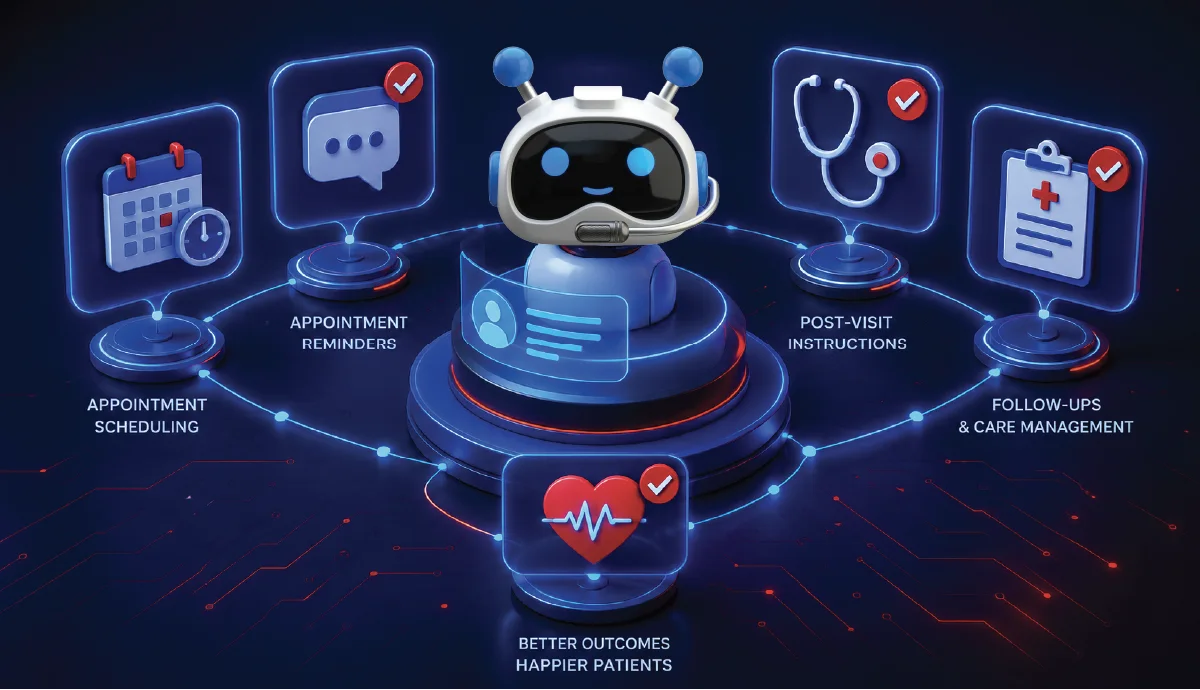
Generic reminder blasts, the same message sent to every patient at the same time, don’t work as well as they used to, and patients have started tuning them out. AI agents in healthcare can do something different: call, text, or message based on when each person is actually likely to respond. Morning texts for some patients. Evening calls for others. That kind of adaptability is part of why AI Patient Engagement scores improve in practices that use it thoughtfully; patients feel noticed rather than processed.
VoXgent.AI’s scheduling agents are built around this logic. Reminders adjust to the person, not the other way around.
2. A Digital Front Desk That Never Closes
It’s 8:30 p.m. A patient wants to know what to bring to tomorrow’s appointment. Or whether their lab results are back. Or if there’s a closer parking garage than the one they used last time. Under the old model, they leave a voicemail and wait until morning. Maybe they remember to check in. Maybe they don’t show up because they were confused about something and didn’t get it sorted in time.
A digital front desk in healthcare that runs around the clock removes that entire failure point. VoXgent.AI’s agents don’t clock out, don’t call in sick, and don’t sound frazzled at 4:55 on a Friday. That consistency, especially outside business hours, is one of the strongest drivers of improved AI Patient Engagement for practices that adopt it.
3. Follow-Ups That Feel Like Somebody Actually Checked
After a visit, a lot of patients are left to figure out next steps on their own. Did the medication help? Is the recovery on track? Is it time to book the follow-up? AI agents can check in on all of this automatically, sending a message a few days after discharge, a nudge about a medication refill, and a reminder about an overdue screening.
What makes these effective isn’t the automation itself; it’s the tone. Generic check-ins get ignored. VoXgent.AI designs its automated patient outreach flows to feel warm and specific rather than like a form letter, which is exactly what patients comment on when they describe the experience.
4. Cutting No-Shows by Making It Easy to Change Plans
No-shows are one of the most expensive problems in outpatient healthcare. Lost revenue, disrupted scheduling, time that could have been offered to someone else. The reason many no-shows happen isn’t that patients don’t care; it’s that something changed and rescheduling felt like too much friction at that moment.
AI agents that send multiple reminders, make rescheduling as simple as replying to a message, and follow up when there’s no response address that friction directly. It’s one of the most measurable improvements clinics see with AI Patient Engagement, and VoXgent.AI clients consistently report fuller schedules within weeks of going live.
5. Actually Reaching Patients in the Language They Speak
This one doesn’t get talked about enough. Healthcare serves deeply multilingual communities, and patients who aren’t comfortable in English often disengage from reminders, miss instructions, or don’t follow up at all, not out of disinterest, but because the communication isn’t reaching them in a way that works.
Conversational AI for clinics that can operate fluently in multiple languages extends AI Patient Engagement to populations that standard outreach has historically underserved. For VoXgent.AI, this isn’t a secondary feature or a nice-to-have. It’s a core design principle. Every patient deserves to be reached in the language that actually lands for them.
What This Means for Your Staff
The question patients ask most when they’re first looking at AI Patient Engagement tools is whether this will make care feel colder. More transactional. Less human. It’s a fair concern, and it’s also, in practice, almost always backwards.
When AI handles the repetitive 70% of calls, confirmations, reminders, and basic FAQ stuff, front-desk staff have real mental space left over. They’re not burnt out by call number forty of the day when the patient who actually needs them walks in. The anxious parent who needs someone to talk her through a confusing diagnosis. The elderly patient who’s lost in the insurance process. The guy who’s just scared about his results and needs a minute.
Better patient communication automation for the routine creates better human communication for everything else. That’s the balance, VoXgent.AI is built around technology that supports what your team does best instead of trying to replace it.
Measuring What Actually Improves
Clinics using AI engagement tools commonly report fewer missed calls, shorter wait times, higher satisfaction scores, and better appointment adherence. None of those metrics matters much in isolation; together, they describe a practice that responds at the speed patients now expect.
VoXgent.AI gives practices dashboards to see exactly what’s shifting over time. That transparency matters, both for trusting the technology and for knowing where to push further. You can’t build on what you can’t see.
What to Look for in an AI Patient Engagement Partner
Not every healthcare AI assistant is built the same. Some sound robotic the moment a conversation goes anywhere unexpected. Some integrate poorly with existing EHR systems and create more work than they save. Some have no real escalation path when a patient needs a human and make that handoff awkward or invisible.
When you’re evaluating tools, the checklist should include natural voice quality that actually holds up in varied conversations; deep integration with your scheduling and EHR systems; clear and smooth escalation paths to live staff; and honest reporting on what the AI is actually doing, not just what it’s supposed to be doing. That’s the standard VoXgent.AI was built to be user-friendly from the start, because a tool that frustrates your patients does more damage than no tool at all.
Where This Is Going
2026 is not the endpoint. As the year plays out, expect AI agents in healthcare to take on more nuanced work: proactive outreach for chronic condition management, smarter triage routing for urgent concerns, and tighter connections to remote monitoring data and wearables. The practices building strong AI Patient Engagement foundations now are going to be better positioned for all of that than the ones playing catch-up.
VoXgent.AI is already developing in that direction, not as a future roadmap promise but as active work. The clinics using it aren’t just solving a 2026 problem. They’re building something that grows with them.
Closing Thought
There’s a version of this that still sounds like hype. AI Patient Engagement as a concept, as a trend, as something practices are “exploring.” That version is a few years behind where things actually are.
What’s happening now is more ordinary than that, in the best possible way. Practices are fielding fewer missed calls. No-shows are dropping. Patients are getting responses at 9 p.m. that they used to have to wait until morning for. Staff are less burned out at the end of the day. Those are real, measurable, unsexy improvements, and they’re what VoXgent.AI was built to deliver. Not theoretical. Not far off. Already working in clinics right now.
See How VoXgent.AI Improves Patient Engagement in Real Practice.