
VoXgent.AI

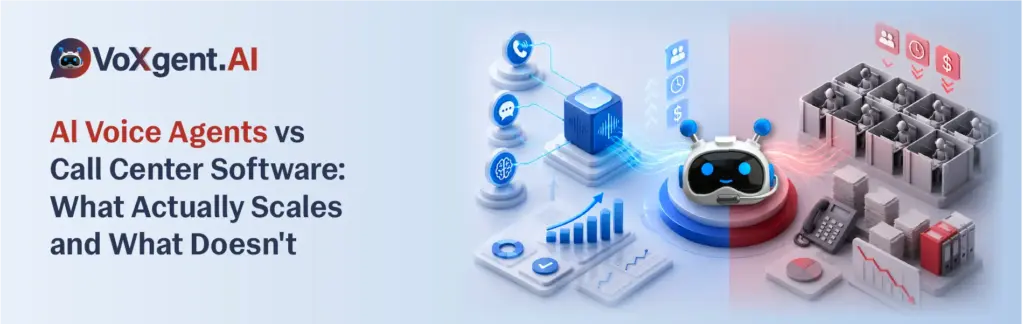
AI Voice Agents vs Call Center Software: What Actually Scales and What Doesn’t
AI-Voice-Agents-vs-Call-Center-Software

Let me be direct If your support strategy still depends on hiring more people every time demand increases, you don’t have a scaling plan. You have a hiring loop, and at some point, that loop breaks. I’ve seen this play out across companies: fast-growing startups, mid-sized teams, and even large enterprises. At first, the system works: More customers → more calls → hire more agents Then suddenly: Costs start climbing faster than revenue Response times slip Teams burn out Customers get frustrated And leadership starts asking:  “Why isn’t this scaling?” The real problem isn’t your team It’s the model. Traditional call center software was built for a different world: Predictable demand Limited channels Business hours support That world doesn’t exist anymore. Today: Customers expect instant responses Demand spikes unpredictably Support is 24/7 by default And most call center setups simply weren’t designed for that. What call center software actually does and where it breaks Let’s be fair; call center tools do their job. They help you: Route calls Track tickets Manage agents But they rely on one assumption: Humans are the system. Which means: Capacity = number of agents Scaling = hiring more agents Cost = grows linearly That’s where things start to crack. Where it struggles the most 1. Scaling is slow. You can’t double your team overnight. But demand can double overnight. 2. You pay for idle time. Your staff for peak… but pay during off-peak too. 3. Experience breaks under pressure. Long wait times. Call transfers. Repeated information. 4. Most work is low-value. A huge chunk of calls are repetitive. “Where’s my order?” “Can I reschedule?” “What’s my status?” And your most expensive resource, people, is handling all of it. That’s not efficient. It’s expensive. Enter AI voice agents and why this shift is happening AI voice agents don’t just improve the system. They change the model. Instead of: People = capacity You move to: System = capacity What AI voice agents actually do better 1. They remove the bottleneck. Answer every call instantly. No queues. No waiting. 2. They handle the repetitive 70% of FAQs, bookings, and status updates done without human effort. 3. They scale instantly; no hiring. No ramp-up. No chaos during spikes. 4. They stay consistent. Same answer quality. Every time. But let’s not oversell it AI shouldn’t handle: Emotional escalations Complex edge cases Relationship-driven conversations That’s still human territory. The model that actually works The best teams don’t choose between AI and humans. They split the work intentionally. AI handles: High-volume inbound calls Repetitive queries First-level support Humans handle: Escalations Complex problems Revenue conversations Simple shift. Big impact. Where VoXgent.AI fits into this This is exactly the gap, VoXgent.AI is built for. Not to replace your system. But to remove pressure from it. What changes when you introduce VoXgent Every call gets answered Repetitive queries disappear from queues Peak volume stops being a crisis Agents focus on meaningful work It doesn’t feel like a big transformation. It just feels… easier. A quick reality check If your plan is “We’ll hire more agents next quarter…” You’re solving for capacity, not scale. What I’d do if I were starting today Keep it simple: Look at your call data Identify repetitive queries Automate those first Measure impact Expand gradually That’s how this actually works. Want to see what this looks like in practice? Instead of guessing, see it with your own use cases. Book a demo with VoXgent.AI Or analyze your last 100 calls and spot what’s repetitive The bottom line Call center software → adds capacity AI voice agents → remove bottlenecks The companies winning right now? They’re not hiring faster. They’re scaling smarter. Still unsure? Let’s make this simple. You don’t need another long evaluation cycle, and you don’t need to figure everything out upfront. The easiest way to understand this is to see it with your own support flows. With VoXgent.AI, you can: See how AI voice agents handle real call scenarios Identify what can be automated immediately Understand impact on cost, speed, and experience No theory. Just clarity.  Book a quick demo and see how your support can scale without hiring more people. Or start with one simple question:  “How many of our calls actually need a human?” FAQs 1. Are AI voice agents actually better than call center software? They’re better at different things. AI handles speed and volume. Traditional systems manage workflows. The real advantage comes from combining both. 2. Will AI voice agents replace support teams? No. They shift how teams work. AI handles repetitive queries, while humans focus on complex interactions. 3. How much of support can be automated? Usually 60–80% of queries are repetitive and can be automated. The rest still need human input. 4. What’s the biggest mistake companies make? Trying to automate everything. AI works best when focused on predictable tasks. 5. How quickly can this be implemented? You can start with one use case and go live in a few weeks, then expand. 6. What ROI should you expect? Lower costs, faster responses, fewer missed calls, and better customer experience. 7. Where does VoXgent.AI fit in? Platforms like VoXgent.AI handle the repetitive layer of support so teams can focus on higher-value work. 8. What should you automate first? Start with high-volume queries like order tracking, scheduling, or account updates. 9. Do customers like talking to AI? They like fast answers. If it’s quick and helpful, they’re fine with it. 10. How do you know if you’re ready? If calls are increasing, agents are overwhelmed, or response times are slipping—you’re ready.

Struggling With High Call Volume? Here’s a smarter fix

Customer Support

At some point, “more calls” stops feeling like growth There’s a stage every growing company hits, and it usually starts off feeling like a win. More calls coming in. More customers reaching out. More activity. For a while, that feels like momentum, and then something shifts. The same increase in calls starts creating pressure. Queues get longer. Customers wait more than they should. Your team is constantly busy, but somehow still behind. That’s usually the moment it clicks: you don’t just have more demand; you need a real, high call volume solution. The obvious fix and why it doesn’t hold up Most teams go straight to hiring. “Let’s add more agents,” and yes, that works… temporarily. But it also brings its own set of problems: New hires take time to train Costs keep creeping up Quality varies from one agent to another Peak hours still feel chaotic You’re adding capacity but not control. That’s why hiring alone rarely solves high call volume in a sustainable way. What’s actually creating the pressure If you sit down and really look at your call data, a pattern becomes obvious pretty quickly. A big chunk of your calls follows the same structure: “Where’s my order?” “Can I reschedule?” “What’s the status?” These aren’t complex conversations. They’re repetitive. And right now, your most valuable (and expensive) resource is your team, which is spending hours handling them. That’s the real bottleneck, and solving that is what unlocks a scalable high call volume solution. A better way to think about it Instead of asking, “How do we handle more calls?” A more useful question is, “Why are humans handling all of these calls?” That one shift changes how you approach the problem. Because once you separate: what actually needs human judgment from what just needs a fast, consistent response …the path forward becomes much clearer. Where VoXgent.AI starts to quietly change things This is where something like VoXgent.AI fits in, not as a full replacement but as support where it actually makes sense. Think about those repetitive, high-volume calls. Instead of sitting in a queue, they get handled instantly. No waiting. No back-and-forth. No routing loops. That’s what call center automation should feel like not just moving calls around, but actually resolving them, and this is where teams begin to genuinely reduce call volume pressure, not by cutting demand, but by handling it differently. What actually changes on the ground The difference isn’t dramatic overnight; it’s subtle but noticeable. Before: Agents jumping between similar queries all day Customers repeating the same information Conversations feeling rushed After introducing voice AI support: Common queries get resolved immediately Agents deal with fewer, more meaningful conversations There’s room to think, not just react It just feels… smoother, and over time, that’s what makes this a practical high call volume solution, not just a temporary fix. The part most teams don’t expect Most teams go into this thinking about cost. But what they notice first is something else entirely. The team sounds less stressed. Mistakes start dropping. Conversations become more focused. That’s what better customer support scaling actually looks like. Not just handling more calls, but handling them better. And customers? They’re simpler than we think There’s a common assumption that customers always want to talk to a human. That’s not really true. What they actually want is: A quick answer No repetition No friction If they get that, they’re happy, and when they do need a human, the experience is better because your team isn’t stretched thin anymore. You don’t need a big transformation to start This doesn’t have to be a massive overhaul. Most teams start small: Pick 2–3 high-volume call types Automate just those Watch what happens Once the pressure drops, expanding becomes an easy decision. That’s how a high call volume solution becomes practical, not overwhelming. When Call Volume Stops Being a Problem and Starts Being an Advantage High call volume isn’t the real issue. Unnecessary, repetitive work is. Once you remove that layer, things start settling down faster than expected: Queues shrink Teams feel more in control Customers get faster resolutions That’s what a real high call volume solution should do, and this is exactly where platforms like VoXgent.AI quietly fit in, helping teams handle volume without constantly reacting to it. If your team feels like it’s always catching up, it might not be a hiring problem. It might be a handling problem. → Book a demo to see how VoXgent.AI can support your high call volume solution → Or start by identifying which 20–30% of your calls don’t need a human today FAQs: High Call Volume & Automation 1. What is the best high call volume solution for growing businesses? The most effective approach is a hybrid model using automation for repetitive queries while keeping human agents focused on complex conversations. 2. Can AI actually reduce call volume? Yes. It doesn’t reduce demand, but it handles repetitive queries instantly, which reduces pressure on your team and eliminates unnecessary queues. 3. Will customers get frustrated talking to AI? Only if the experience is slow or robotic. When responses are quick and accurate, most customers prefer speed over who (or what) is answering. 4. How do I know which calls to automate? Start by looking at your most frequent queries; anything repetitive and predictable is a good candidate. 5. Is call center automation expensive to implement? Compared to scaling a support team, it’s usually more cost-efficient. Most teams recover the cost quickly once volume starts getting handled automatically.

Schedule Your Voxgent.AI Demo

Let’s show you how VoXgent.AI can transform your customer experience.