


I’ll say what most teams won’t
IVR was never built for customers. It was built for operations, and for a long time, that trade-off was acceptable. You could make people wait. You could make them press buttons. You could move them through a system instead of actually helping them. Because there weren’t many alternatives. That’s not true anymore.
Where IVR starts falling apart in real life
This isn’t theory. This is what actually happens.
A customer calls. They hear: “Press 1 for support… Press 2 for billing…” They guess. They get it wrong. They go back. They wait. They finally reach someone… and then repeat everything. No one says, “Wow, that was smooth.” At best, they tolerate it. At worst, they hang up, and most companies don’t even realize how often that happens.
What IVR is really doing behind the scenes
IVR is basically a routing layer. That’s it. It doesn’t solve problems. It just decides where the problem should go. So even if you “scale” IVR, you’re still pushing work to humans.
Which means:
- More calls → more agents
- More agents → more cost
- More cost → constant pressure
It’s a loop.
Voice AI changes one thing (but it’s a big one)
Instead of routing the problem… It tries to solve it. That’s the shift. Not: “Where should this call go?” But, “Can we handle this right now?”
The difference shows up immediately
When someone interacts with voice AI, the flow feels different. There’s no “Press 1… Press 2…” It starts with “How can I help?” And that small change does a lot:
- People explain the issue naturally
- The system understands intent
- The response comes faster
- Context doesn’t reset
It feels less like navigating a system… and more like talking to someone who already gets it.
Let’s talk about where this actually matters
Not every call needs AI. Not every system needs to change. But here’s where IVR clearly struggles:
- High call volume
- Repetitive queries
- Peak hour pressure
- Multi-step navigation
And here’s where Voice AI works well:
- First-level support
- FAQs and status checks
- Booking and scheduling
- Call deflection (done right)
If most of your calls look like the first list… you already know the answer.
Where VoXgent.AI fits into this
What I’ve seen work best is not a full replacement. It’s layering. Instead of ripping out IVR overnight, teams introduce something like VoXgent.AI on top of it. And then:
- Repetitive calls stop reaching agents
- Customers get answers immediately
- Call queues shrink without hiring
- Agents stop repeating the same things all day
It doesn’t feel like a “transformation project.” It feels like removing friction that shouldn’t have been there in the first place.
The part that usually surprises teams
Most people expect cost savings. That happens. But what they notice first is different:
- Fewer frustrated customers
- Shorter conversations
- Less back-and-forth
- Calmer support teams
That’s when it clicks. This isn’t just automation. It’s a better flow.
A quick comparison without the fluff
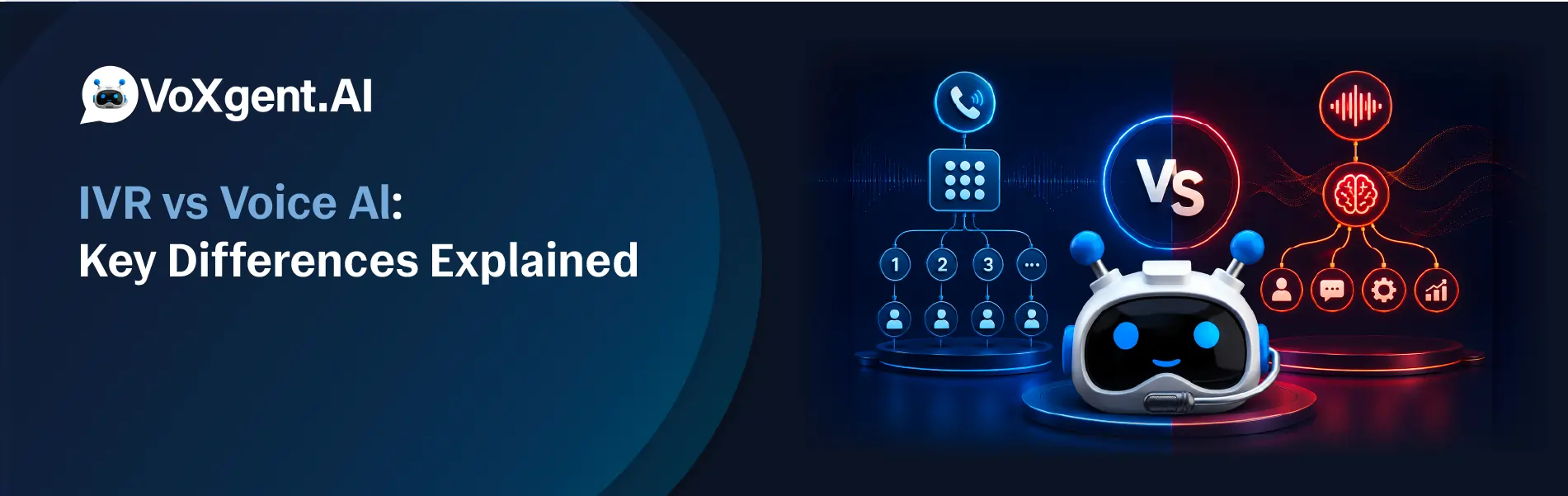
IVR:
- Routes calls
- Menu-based
- Slower resolution
- Depends heavily on agents
- Scales cost with demand
Voice AI:
- Resolves calls
- Conversational
- Faster outcomes
- Reduces agent load
- Scales without hiring
You don’t need a 20-row table to see the difference.
What I’d actually do if I were you
Not a full overhaul. Just this:
- Pull your last 200 calls
- Identify the top 5 repeated queries
- Ask: “Why are humans handling these?”
That’s your starting point. Not strategy decks. Not vendor comparisons. Just reality.
If you want to see how this plays out
The easiest way to understand this isn’t reading more. It’s seeing your own call flow run through it. With VoXGent.AI, you can:
- Test real scenarios (not demos that feel staged)
- See where IVR creates friction
- Identify what can be handled instantly
Or honestly do this first: Call your own support number and count how many steps it takes to get an answer. That number tells you everything.
Still unsure? Here’s the simplest way to decide
You don’t need another comparison blog. You need clarity on your own system. With VoXgent.AI, you can:
- See how your current call flow behaves without IVR friction
- Understand what can be automated immediately
- Measure impact before making any big change
Book a quick demo and see the difference in your own setup. Or start with one question:
“How many steps does it take for a customer to get an answer today?” If that number feels high… you already know what needs to change.